Philadelphia Deed Fraud: How to Protect Your Property With a Free Fraud Alert
Philadelphia offers a free Deed Fraud Guard email alert service that notifies property owners whenever a document containing their name is recorded in the City's land records — here's how it works, how to sign up, and what to do if you get a suspicious alert.
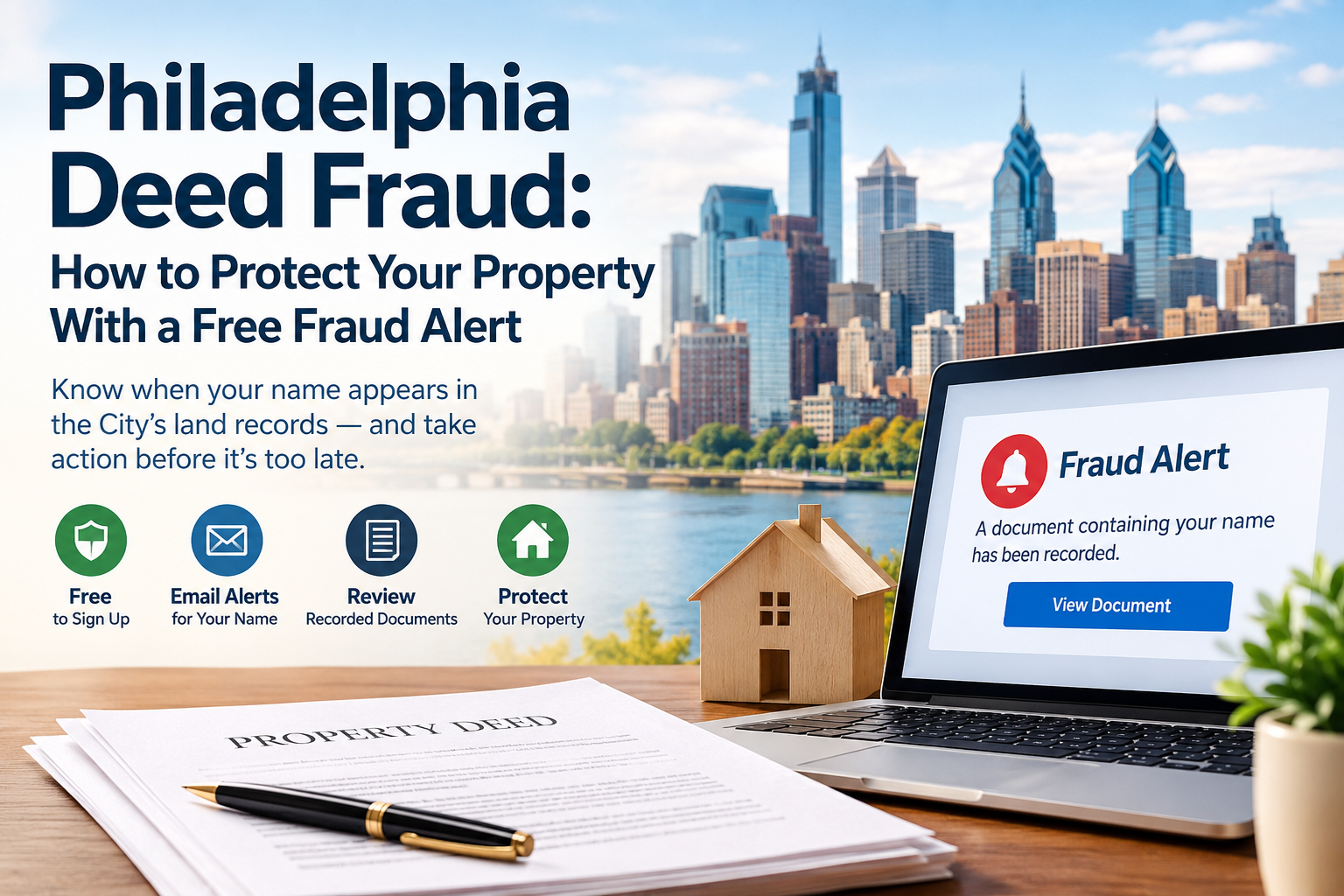
If you own property in Philadelphia, there is a simple and free step you can take to help protect one of your most valuable assets: sign up for Philadelphia's Deed Fraud Guard.
Property owners often assume that because their name is on the deed, their property is automatically protected from someone attempting to transfer or mortgage it. Unfortunately, deed fraud can happen when someone creates fraudulent documents and attempts to record them with the Philadelphia Department of Records.
The good news is that Philadelphia provides a free email alert service called Deed Fraud Guard that can help property owners discover suspicious activity involving their name.
Why Is Deed Fraud Important?
Your deed is the legal document that establishes ownership of your property.
A deed-fraud scheme generally involves someone attempting to make it appear that they are the legal owner of a property — or have authority to act for the owner — when they do not.
Philadelphia defines deed fraud as someone selling a property while pretending to be the owner without the owner's permission. Mortgage fraud can occur when someone signs a mortgage against a property they don't own in order to borrow money.
The consequences can be serious.
If a fraudulent deed is recorded, the person committing the fraud may attempt to:
- Sell the property.
- Transfer ownership to another person.
- Take out a mortgage or other loan against the property.
- Create additional fraudulent documents.
- Make it more difficult for the legitimate owner to establish what happened.
The Philadelphia Department of Records explains that fraudulent ownership changes can leave the legitimate owner having to take legal action to establish their ownership.
For landlords, the risk can be particularly important because an owner may have multiple properties, including properties that are vacant or occupied by tenants. An owner may not regularly visit every property or immediately notice something unusual.
A Realistic Example of Deed Fraud
Imagine that John owns a rental property in Philadelphia.
John lives in another state and owns several rental properties. One of his Philadelphia properties is occupied by a tenant, so John doesn't personally visit the property very often.
A criminal obtains information about the property and attempts to create a fraudulent deed showing that the criminal has authority to transfer the property.
The fraudulent document is submitted for recording.
If the transaction succeeds, the criminal could potentially attempt to sell the property or borrow money against it.
John might not immediately know that something happened to his property.
Where Fraud Guard Can Help
Suppose John has previously registered for Philadelphia's Deed Fraud Guard.
When a document containing John's registered name is recorded, Fraud Guard sends him an email notification.
John receives an unexpected alert.
He reviews the document and realizes that he did not authorize the transaction.
That early warning gives John an opportunity to take action before the situation becomes even more complicated.
Philadelphia specifically describes early identification as important because it can help property owners determine whether a transaction is fraudulent and take steps to protect their ownership rights.
The key point is that Fraud Guard is an alert system — it does not itself prevent every fraudulent transaction.
Its value is giving the property owner an opportunity to discover something suspicious.
What Is Philadelphia's Deed Fraud Guard?
Deed Fraud Guard is a free email notification service provided by the Philadelphia Department of Records.
Property owners can register their name and email address.
When a document is recorded with their registered name, the system sends them an email notification. The notification allows the owner to access an unofficial copy of the recorded document online so they can review it.
The service isn't limited to deeds.
Philadelphia says alerts can be triggered when a person's name appears on documents such as:
- Deeds
- Mortgages
- Other recorded documents
This makes it useful for property owners who want another layer of awareness around activity involving their name in Philadelphia's land records.
How Much Does It Cost?
Nothing.
Philadelphia's Deed Fraud Guard is free for Philadelphia property owners.
There is no subscription fee to register for the service.
That makes it a particularly easy precaution for homeowners, landlords, investors, and families who own Philadelphia real estate.
How Do You Sign Up?
The City provides an online registration process for Deed Fraud Guard.
You register your first name, last name, and email address.
You can start from Philadelphia's official Sign Up for Deed Fraud Protection page: Philadelphia Deed Fraud Guard — Official Sign-Up Page
The City also provides a broader property-fraud information page: Philadelphia Department of Records — Deed & Mortgage Fraud Resources
What Happens After You Sign Up?
Once your name is registered, Philadelphia's system monitors recorded documents for that name.
If a document is recorded containing your registered name, you'll receive an email notification.
You can then review the recorded document.
For example, imagine receiving an email saying a mortgage was recorded involving your name.
If you recently refinanced your property, the alert may be completely legitimate.
But if you haven't signed a mortgage, sold a property, transferred ownership, or authorized someone to act on your behalf, the notification deserves immediate attention.
Don't assume an unexpected recording is legitimate simply because it appears in the City's records.
Review the document and contact the Department of Records if you believe something is wrong.
What Should You Do If You Receive a Suspicious Alert?
If you receive an alert about a document you don't recognize, don't ignore it.
First, review the document.
Then contact the Philadelphia Department of Records if you believe the transaction may be fraudulent.
The City provides an online process for reporting suspected deed or mortgage fraud.
The Department of Records can be contacted at:
- Philadelphia Department of Records
- Phone: 215-686-2290
- Email: records.info@phila.gov
The City advises suspected victims to report the matter immediately and also recommends contacting law enforcement and obtaining appropriate legal assistance.
It is important to understand that the Department of Records is not an investigative agency. It tracks fraud reports and can refer victims to appropriate legal resources while cooperating with law enforcement and courts.
Philadelphia Has Also Added Additional Fraud Protection
Fraud Guard isn't the City's only effort to combat deed fraud.
In 2025, Philadelphia introduced a system designed to detect a particular type of fraudulent deed before it is recorded.
The system checks whether the person whose name appears as the property owner was deceased at the time the deed was supposedly signed. If the system identifies a potential conflict, the deed can be flagged rather than automatically recorded.
For example, a criminal might attempt to forge a deceased homeowner's signature and create a deed transferring the property.
Philadelphia's new verification system can identify situations in which the recorded owner had already died before the supposed transfer.
If the transfer is legitimate and the system made an error, the parties can provide documentation showing that the owner was alive, signed the deed, and authorized the transfer.
This is an important distinction:
Fraud Guard helps alert property owners after a document involving their name is recorded, while Philadelphia's newer verification system is designed to stop certain fraudulent transfers before recording.
Together, these systems provide different layers of protection.
What Else Can Philadelphia Property Owners Do?
Fraud Guard should be considered one part of a broader property-protection strategy.
Philadelphia recommends property owners take several practical steps, including:
- Check on vacant properties regularly.
- Keep up with property maintenance.
- Pay attention to property tax and water bills.
- Make sure important mail is reaching you.
- Pay attention to unfamiliar correspondence from banks or mortgage companies.
- Verify ownership and seller identity when purchasing property.
- Consider title insurance.
- Use qualified professionals when buying or selling real estate.
Vacant properties deserve particular attention because an owner who rarely visits the property may be less likely to notice something unusual.
What About Landlords With Multiple Properties?
This is particularly relevant for Philadelphia landlords.
If you own one property, monitoring your property records is relatively straightforward.
If you own 10, 20, 50, or more properties, keeping track of every property and every ownership-related document becomes considerably more difficult.
That makes automated alerts particularly useful.
A landlord shouldn't have to discover a potential ownership problem months later because they happened to order a title search or receive an unexpected letter.
An email alert can provide an additional opportunity to investigate.
A New Philadelphia Law May Also Help Some Fraud Victims
Philadelphia has also taken another step to address the financial consequences of deed fraud.
In February 2026, the City announced a new law allowing certain victims who successfully prove deed fraud in court to seek a refund of the Philadelphia Realty Transfer Tax that was paid on the fraudulent transaction.
The requirements include obtaining a court ruling that the deed was fraudulent and an order voiding the fraudulent deed. The refund is limited to the applicable Philadelphia portion of the Realty Transfer Tax.
This does not eliminate the costs or complications associated with deed fraud, but it provides another potential remedy for qualifying victims.
The Bottom Line
Your property may be one of the largest assets you own.
You don't have to pay for Philadelphia's Deed Fraud Guard, and signing up takes only a few minutes.
For Philadelphia homeowners and landlords, there is little reason not to take advantage of a free alert that can notify you when a recorded document contains your name.
Fraud Guard doesn't guarantee that fraud cannot happen.
Instead, it provides something extremely valuable: awareness.
If someone records a document involving your name, knowing about it quickly gives you an opportunity to investigate the transaction and take appropriate action.
For Philadelphia property owners, that's a simple additional layer of protection for an extremely valuable asset.
Protect Your Property Before You Need To
If you own Philadelphia real estate, take a few minutes today to register for the City's free Deed Fraud Guard service.
And if you own multiple rental properties, consider creating a simple property-protection checklist that includes deed monitoring, tax and utility-bill monitoring, insurance reviews, property inspections, and regular review of your ownership records.